You have probably seen it on a spa menu somewhere between the hot stone and the deep tissue: herbal compress. Maybe it was written as potli, or herbal ball, or hot compress. The price tag was higher than a standard oil massage, the description was three vague lines about ancient wisdom, and you closed the tab.
Fair enough. This guide is the explanation that menu should have given you – written for someone in Chennai who is deciding whether to spend an hour and a half, and four thousand rupees, on something they have never tried.
Quick answer: Herbal compress massage is a treatment in which a bundle of herbs, wrapped tightly in cotton cloth, is steamed until hot and then pressed, rolled and dabbed over the body – usually alongside a conventional oil or dry massage. It combines moist heat, gentle pressure and herbal aroma, and typically runs 60 to 90 minutes.
Table of Contents
What Herbal Compress Massage Actually Is
The compress itself is the whole point. A therapist takes a blend of dried or fresh herbs, gathers them into a cotton cloth, ties the corners into a fabric ball with a twisted handle, and steams it. When it comes out of the steamer it is hot, damp, fragrant, and roughly the weight of a large orange.
That warm bundle is then worked over your body – pressed into the shoulders, rolled along the spine, dabbed down the backs of the legs. The heat is moist rather than dry, so it spreads into the tissue differently from a hot water bottle or a heating pad. Most people describe the sensation as heavy, warm and oddly comforting.
In Thailand, where the technique is best documented, it is called Luk Pra Kob – loosely, “herbal pressing ball” – and it has long been used alongside traditional Thai massage rather than as a standalone treatment.
The potli connection
Here is the part almost no spa page explains, and it causes real confusion in India.
If you have grown up around Ayurveda, you already know this treatment under a different name. Potli massage, and the related Ayurvedic technique of kizhi (including elakizhi, made with medicinal leaves, and podikizhi, made with herbal powders), use the same basic principle: herbs bundled in cloth, warmed, and applied to the body.
The traditions are separate and their herb blends and philosophies differ – Ayurvedic kizhi is usually prepared in medicated oil and prescribed within a dosha framework, while the Thai compress leans on steam and aromatic herbs. But if you search for “herbal compress” and find yourself reading about potli, you have not taken a wrong turn. They are cousins.
So when a Chennai spa lists a “hot herbal compress,” ask which tradition it draws from. The answer tells you a lot about what the session will feel like.
What Goes Inside a Herbal Compress
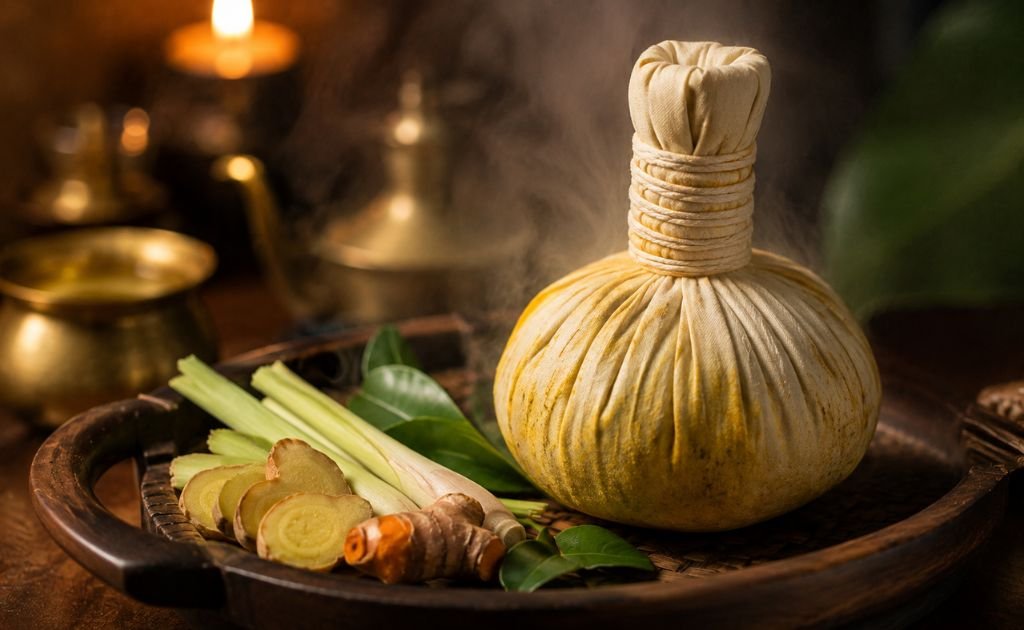
There is no single universal recipe, and any page that presents one as definitive is overstating it. Blends vary by country, by lineage, by spa, and sometimes by season.
That said, the herbs that appear most consistently in the Thai tradition include:
- Lemongrass – the dominant citrus-green note in most blends
- Ginger – warming, sharp, aromatic
- Turmeric – earthy; also what tints the cloth yellow
- Kaffir lime – bright, distinctly Southeast Asian
- Camphor – cooling and penetrating on the skin
- Tamarind leaf and plai (a ginger relative) in more traditional preparations
Ayurvedic potli blends may instead use leaves such as nirgundi or eranda, herbal powders, rock salt, or rice, often with medicated oil.
Before you book, ask the spa what is actually in their compress. It is a completely reasonable question, and a good spa will answer it without hesitating. Ask particularly if you have any known plant, spice or fragrance sensitivity – turmeric and camphor are common irritants for some skin types.
How a Session Works, Step by Step
A well-run herbal compress session follows a fairly predictable rhythm.
- A short consultation. The therapist should ask about injuries, recent surgery, skin conditions, pregnancy, medication, and how you feel about heat. If nobody asks you anything, that is a warning sign.
- A conventional massage first. Most spas begin with 20 to 30 minutes of oil or dry massage to warm the muscles. The compress is rarely used cold-start.
- The compresses are steamed. Usually two, so one stays hot while the other is in use. You will often notice the aroma before you see them.
- The temperature is tested. The therapist should press the compress against their own forearm, then briefly against your upper back or shoulder, and ask whether the heat is comfortable. This step is not optional. Speak up if it is too hot – it is far easier to adjust than to undo.
- Application begins. The technique alternates between dabbing (quick touches to acclimatise the skin), pressing (holding the compress in place so heat sinks in), and rolling (moving it along muscle lines).
- Compress and hands alternate. As the ball cools, the therapist swaps it for a fresh one and works the area with their hands in between.
- A settling period. Most sessions close with slower, quieter work while the warmth is still in the tissue.
- Aftercare. You will usually be advised to drink water, avoid a very hot shower for a few hours, and let the herbal residue stay on the skin for a while.
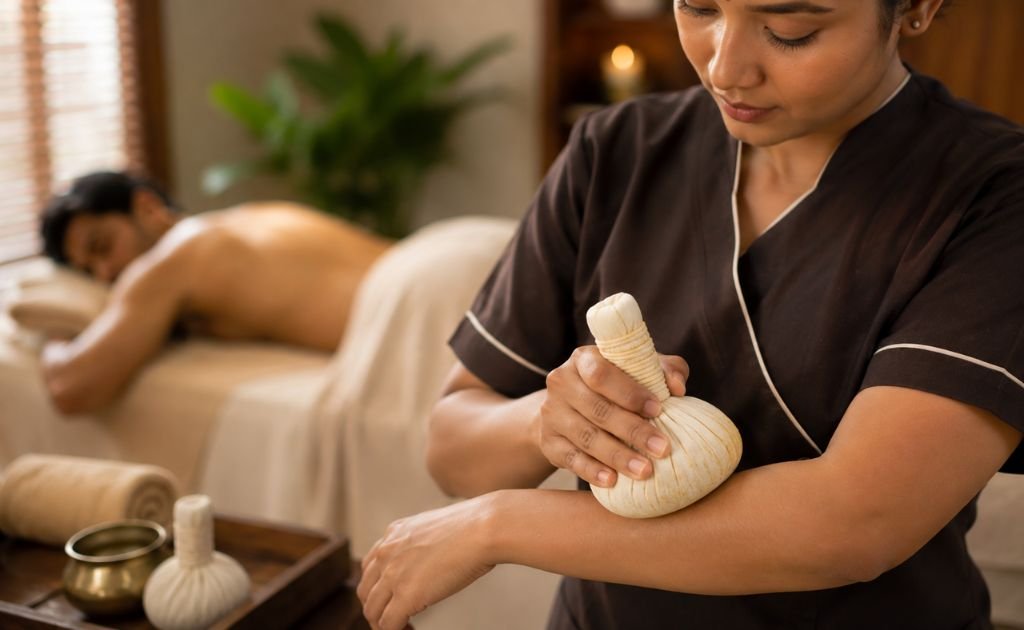
A full-body session generally runs 60 to 90 minutes. Shorter versions targeting only the back, neck and shoulders exist at some spas.
What It Feels Like the First Time
The first thing is the smell. It arrives before the compress does – sharp, green, faintly sweet, closest to lemongrass and ginger. It fills the room and stays on your skin for hours afterwards.
Then comes the weight. The compress is heavier than most people expect, and the first contact is a firm, hot press rather than a stroke. There is a brief moment of that’s hot that settles within a second or two into something more like sinking into a warm bath. Along the shoulders and lower back, where most of us hold tension, the sensation is the closest thing in a spa to relief that you can actually feel arriving.
The rhythm is slower than a Swedish massage and less demanding than a Thai dry massage. There is no stretching, no elbows in the glutes, nothing to brace for. Most first-timers find themselves drifting somewhere around the twenty-minute mark.
Afterwards, the skin feels warm and slightly tacky, and there is a lingering herbal scent on your arms. Many people report feeling pleasantly heavy and a little sleepy – which is worth planning around if you have a meeting that evening.
What the Benefits Realistically Are
Spa marketing has done this treatment no favours. You will find pages claiming it detoxifies the body, cures inflammation and boosts immunity. Those claims are not supported, and you should be sceptical of any spa that makes them.
Here is a more honest picture.
What most people reliably experience:
- Deep relaxation, often deeper than with oil massage alone, because heat and aroma work together
- A temporary easing of muscle tightness, particularly across the shoulders, neck and lower back
- A pleasant, memorable sensory experience – the warmth and scent are a large part of the appeal
- A sense of calm afterwards that many find helps with winding down and sleeping
What the research suggests, carefully stated: massage therapy in general has evidence for short-term relief of low-back and neck pain, though the US National Center for Complementary and Integrative Health describes that evidence as modest and the benefits as generally short-lived. Trials comparing traditional Thai massage with and without herbal compress in older adults with low back pain have been published, but the body of evidence is small. Warmth applied to muscle is well established as comfortable and temporarily relaxing – it is not a treatment for a diagnosed condition.
What it is not: herbal compress massage does not treat arthritis, migraine, skin disease or chronic pain conditions. If you are dealing with persistent pain, see a doctor. A spa treatment can sit alongside medical care; it does not replace it.
Herbal Compress Compared With Other Treatments
| Massage | Main feature | Experience | Tends to suit |
| Herbal compress | Steamed herb bundles pressed and rolled over the body | Warm, aromatic, slow, gently weighted | Anyone wanting heat plus a strong sensory element |
| Hot stone | Heated basalt stones placed and glided over the body | Warm, smooth, still; dry heat | People who want heat without fragrance |
| Thai dry massage | Assisted stretching and rhythmic pressure, fully clothed | Active, sometimes intense; no oil | People who feel stiff rather than sore |
| Ayurvedic abhyanga | Synchronised warm-oil strokes following a dosha framework | Slow, oily, deeply sedating | People wanting a traditional, ritualised session |
| Swedish | Long gliding and kneading strokes on surface muscle | Predictable, easy, unintimidating | First-timers and anyone wanting straightforward relaxation |
There is no best option here, only a best fit. If you dislike strong scents, hot stone will suit you better. If you want to be worked on rather than warmed, Thai dry massage is the answer. Herbal compress is for people who want heat, aroma and slow pressure at the same time.
Who Tends to Enjoy It – and Who Should Be Careful
It usually appeals to people who like warmth, people curious about traditional Thai or Ayurvedic wellness, anyone who finds conventional massage a bit flat, desk-bound people carrying shoulder and neck tension, and anyone who values the ritual side of a spa visit as much as the physical one.
Be cautious, and speak to a doctor first, if you are pregnant or recently postpartum; you have diabetes or any condition affecting sensation in the skin (reduced sensation is the main reason heat injuries happen); you have eczema, psoriasis, open wounds, recent burns or unhealed scars; you have a circulatory condition, varicose veins or take blood thinners; you have a fever or an active infection; you have a known allergy to any herb in the blend.
On heat, specifically. A hot compress can burn. This is not a theoretical concern – a case of a full-thickness burn requiring skin grafting following Thai herbal hot compress therapy has been published in the medical literature (Burns Open, 2021). It is rare, and it is avoidable: a competent therapist tests temperature on themselves first, checks with you, and keeps the compress moving. Your part is to say something the moment the heat stops being pleasant. If your skin stays red for more than a few hours, or blisters, treat it as a burn and follow standard burn first aid guidance – cool running water for 15 to 30 minutes – and seek medical attention if it is anything more than mild.
What to Check Before You Book in Chennai
Chennai has plenty of spas advertising herbal or potli treatments, and quality varies more than price does. Before you book, it’s worth asking:
- What is actually in the compress? A spa that can answer specifically is a spa that knows what it is doing.
- Are compresses reused, and how are they stored? Ask directly. Practices differ, and you are entitled to know.
- How is the temperature managed? The answer should involve testing on skin and checking with you – not just “it’s warm.”
- What training do the therapists have in this specific technique? Compress work is a distinct skill; general massage certification is not the same thing.
- Is there a consultation before the treatment? There should be.
- How long is the actual session? Confirm whether the quoted duration includes the preliminary massage.
- What does it cost, all in? Ask about taxes and whether the price differs by branch.
- Is the treatment room private, and is a same-gender therapist available if you prefer one?
In Chennai, expect a full 90-minute herbal compress session at an established spa to sit broadly in the ₹3,500–₹5,000 range, with shorter or targeted versions costing less. Anything dramatically below that is worth a few extra questions.
Herbal Compress massage at Ashlee Spa & Salon
Ashlee Spa & Salon has operated in Chennai since 2016 and runs branches in Velachery, Mylapore, Tambaram, Perumbakkam, Thoraipakkam, Pallavaram, and SkyOne., each with its own address and phone line.
A Hot Herbal Compress treatment is listed on the Ayurveda therapy menu at 90 minutes, ₹4,300, described as using traditional Thai herbs. Related heat-based and traditional treatments on the menu include hot stone massage, Thai dry massage, and full-body Ayurvedic massage.
Two honest notes. Availability of the compress treatment can vary by branch and by day, since it depends on which therapists are rostered – so confirm before you travel. And as with any spa anywhere, the questions in the section above are worth asking here too; a spa that welcomes them is one worth booking.
How to Enquire
If you would like to try a herbal compress or another traditional treatment, call your nearest branch to confirm current availability, session length and suitability for you – particularly if you have any of the health considerations listed above.
If you are not sure the compress is right for you, say so when you call. A short conversation about what your shoulders actually feel like will get you a better recommendation than any menu will.
Frequently Asked Questions
What is herbal compress massage?
Herbal compress massage is a treatment in which herbs wrapped in cotton cloth are steamed until hot, then pressed, rolled and dabbed over the body, usually alongside an oil or dry massage. It combines moist heat, gentle pressure and herbal aroma. In Thailand it is known as Luk Pra Kob.
Is herbal compress massage the same as potli massage?
They are closely related but not identical. Both use herbs bundled in cloth and warmed before application. Thai herbal compress relies on steam and aromatic herbs; Ayurvedic potli or kizhi is usually prepared with medicated oil and prescribed within a dosha framework.
What herbs are used in a herbal compress?
Thai blends commonly include lemongrass, ginger, turmeric, kaffir lime, camphor and plai. Ayurvedic potli may use medicinal leaves, herbal powders, rock salt or rice. Recipes vary by spa, so ask what is in theirs before booking.
How long does a herbal compress massage take?
Most full-body sessions run 60 to 90 minutes, including an initial oil or dry massage before the compress work begins. Shorter targeted versions for the back, neck and shoulders are offered at some spas.
What does herbal compress massage cost in Chennai?
At established Chennai spas, a 90-minute session typically falls broadly in the ₹3,500–₹5,000 range. Prices vary by spa, session length and whether the compress is part of a longer package.
Does a herbal compress massage hurt?
It should not. The pressure is moderate and the technique is slower than Thai dry massage. The main sensation is heat, which should feel comfortably warm rather than sharp. Tell your therapist immediately if it is too hot.
Is herbal compress massage safe for everyone?
No. Anyone who is pregnant, has diabetes or reduced skin sensation, active skin conditions, circulatory problems, a fever, or a known herb allergy should speak to a doctor first and always tell the therapist before the session.
How is herbal compress different from hot stone massage?
Hot stone uses smooth heated basalt stones and delivers steady dry heat with no fragrance. Herbal compress uses steamed herb bundles, so the heat is moist and is combined with a strong herbal aroma and a softer, more textured contact.
Where can I get a best herbal compress massage in Chennai?
Several Chennai spas list herbal compress or potli treatments, including Ashlee Spa & Salon, which lists a Hot Herbal Compress on its Ayurveda therapy menu. Availability can vary by branch, so call ahead to confirm.