If you have been researching spa franchises, you will have noticed that the headline number is rarely the number you actually spend. One brand says “₹35 lakhs”, another “₹40 lakhs onwards”, a directory lists the same brand at ₹15–20 lakhs, and none of them tells you whether that covers the property deposit, the first months of therapist salaries or GST on the franchise fee.
A spa franchise investment is a stack of costs – franchise fee, interiors, equipment, rent and deposit, staffing, training, launch marketing, technology and working capital – followed by a second stack of ongoing fees once the doors open. Each layer depends on the brand, format, city, property and who runs the spa day to day.
This guide walks through every layer so you can read any franchise proposal, including ours at Ashlee Spa & Salon, with clear eyes. Every figure quoted is published by the brand or directory named, with the date checked. We have not invented an “industry average”, and we have not put a price on an Ashlee franchise, because that depends on your location and format and belongs in a direct conversation.
Table of Contents
How Much Does a Spa Franchise Cost?
There is no single spa franchise cost. Published Indian examples we checked in August 2026 range from roughly ₹10 lakhs for a compact foot-spa or kiosk format to ₹1 crore or more for a large premium wellness spa. The biggest drivers are the brand, the format (compact, day spa or premium wellness spa), the city and micro-location, carpet area, interior specification, equipment, working capital and whether the franchisor or the franchisee operates the unit.
Three published reference points help anchor expectations – competitor and directory data, not Ashlee pricing:
- FranchiseBazar (directory, checked 21 Aug 2026) groups Indian spa franchises into a compact model at “around ₹10–15 lakhs” (250–500 sq ft), a standard day spa at “around ₹20–35 lakhs” (600–1,200 sq ft) and a premium wellness spa at “₹40 lakhs–₹1 crore or more” (1,200–2,000+ sq ft).
- Tattva Spa (brand page, checked 21 Aug 2026) states “₹40 lakhs onwards” for 1,200–1,500 sq ft; other Tattva pages quote ₹50–80 lakhs, and its Chennai page quotes ₹15–40 lakhs for smaller formats – a useful reminder that the same brand can publish very different numbers for different formats and dates.
- Allure Thai Spa (brand page, Mumbai, checked 21 Aug 2026) is one of the few to publish the full stack: ₹35–40 lakhs for a 700–800 sq ft unit with a ₹5 lakh + GST franchise fee, or ₹45–60 lakhs for 900–1,200 sq ft with a ₹10 lakh + GST fee, plus 15% royalty on monthly revenue.
Spa Franchise Cost Breakdown: The 12 Components
| Investment Component | What It Covers | What Makes It Rise or Fall |
| Franchise fee | One-time payment for brand rights, onboarding and usually initial training. Published Indian examples run from about ₹3–6 lakhs (FranchiseBazar range) to ₹15 lakhs or more for larger brands; GST is usually extra | Brand strength, format, territory size, what is bundled |
| Interior setup | Civil work, partitions for treatment rooms, flooring, false ceiling, plumbing for wet areas, electricals, painting | Positioning (premium vs compact), condition of the shell, per-sq-ft finish level, mall vs street fit-out rules |
| Equipment | Treatment beds, steam/shower units, hot-stone warmers, towel cabinets, trolleys, laundry machines | Number of rooms, wet vs dry rooms, imported vs domestic brands |
| Furniture | Reception desk, waiting lounge seating, pedicure chairs, lockers, storage | Quality tier and room count |
| Rent / deposit | Security deposit (commonly several months’ rent in Chennai commercial leasing), advance rent, brokerage, registration | Micro-location, floor (ground vs upper), mall vs high street |
| Licensing & compliance | Shops & Establishment registration, trade licence, GST registration, any police/local-body NOCs applicable to spas in Tamil Nadu, fire safety, signage permissions | City rules, property type, professional fees |
| Staffing (pre-launch) | Recruitment, relocation or joining advances, first month’s payroll before revenue | Number of therapists, experience level, local labour market |
| Training | Franchisor training (often in the fee), travel and stay, lost wages during training weeks | Duration, location of training, batch size |
| Initial inventory | Oils, scrubs, wraps, linen sets, disposables, retail products | Menu breadth, retail ambition, minimum order quantities |
| Launch marketing | Signage, soft-launch event, local digital ads, listings, opening offers | Competition density, brand awareness in your area |
| Technology | Booking/POS software, payment terminals, CCTV, Wi-Fi, music system | Whether the franchisor mandates a platform and charges for it |
| Working capital | Reserve to fund rent, salaries, utilities and consumables until revenue stabilises | Ramp-up speed, fixed cost base, seasonality |
The first five rows usually account for most of the outlay; the last row is the one most often underestimated.
Franchise Fee vs Total Investment: Do Not Confuse the Two
The franchise fee is what you pay the franchisor for the right to use the brand. Depending on the agreement it may also cover initial training, onboarding, layout guidance and launch support. It is a fraction of what you will spend.
The total initial investment is everything required to open: property deposit and advance rent, interiors, equipment, furniture, inventory, licences, staffing, marketing, technology and the franchise fee itself.
Working capital is a third number – the operating reserve you hold back after opening.
When a brand page says “investment from ₹35 lakhs”, ask: does it include the franchise fee, the property deposit and working capital? In many published examples at least one answer is “no”, which is how a ₹30 lakh headline becomes a ₹45 lakh cheque. Never assume what a brand includes – ask for a written cost schedule attached to the agreement.

Spa Franchise Cost in Chennai: Location Economics
Chennai is one of the more active spa franchise markets in South India – Le Bliss Spa, Green Day Spa, Naturals and Green Trends are all headquartered here, and national chains target the city. That activity also shapes your costs.
Commercial rent and deposit. Ground-floor high-street space in Anna Nagar, Nungambakkam, Adyar or Velachery commands a premium over second- and third-floor units on arterial roads such as GST Road, OMR or Medavakkam–Sholinganallur Main Road. Many operating spas in Chennai – including several Ashlee branches – sit on upper floors precisely because the rent-to-footfall trade-off works better for an appointment-led business than for impulse retail.
Mall versus high street. Mall units (Ashlee operates one at Ampa SkyOne, Aminjikarai) bring footfall and longer hours but usually higher rent, common-area maintenance charges and stricter fit-out rules. High-street units are cheaper to fit out but depend on your own marketing.
Target market and competition. IT corridors (OMR, Sholinganallur, Perumbakkam, Thoraipakkam) support weekday-evening and weekend demand from salaried professionals; older residential hubs (Mylapore, T Nagar, Tambaram) draw families and repeat local clients. Density of competing spas within two kilometres affects both your pricing power and your launch marketing budget.
Access and parking. Two-wheeler parking and auto access matter in Chennai; a unit that is hard to reach pays for it in no-shows.
Published Chennai-relevant examples (competitor/directory data, checked 21 Aug 2026): Le Bliss Spa’s own franchise site quotes “35 lakhs” with a 10% royalty; SMERGERS lists Green Day Spa at roughly ₹26–52 lakhs with a ≈₹7 lakh fee, 15% royalty and 1,500–2,000 sq ft; Tattva’s Chennai page quotes ₹15–20 lakhs for its smaller Pavilion format and ₹30–40 lakhs for its Wellness format. These are not Ashlee figures and should be verified with each brand.
How Much Space Does a Spa Franchise Need?
Brands publish requirements from under 500 sq ft for compact formats to 2,000 sq ft and above for premium spas, so there is no universal number. What matters is how the space divides up:
- Reception and waiting – first impression, retail display, billing.
- Treatment rooms – the revenue engine; each room is a capacity unit. Couples rooms and wet rooms (steam, shower) need more area and plumbing.
- Washrooms and changing – non-negotiable for hygiene and for longer therapies.
- Storage – oils, linen, consumables; under-provisioned storage shows up as clutter in treatment rooms.
- Staff area – a small rest and changing space improves therapist retention.
- Laundry – in-house washing and drying, or space for managed linen exchange.
- Customer flow – guests should move from reception to treatment to washroom without crossing a staff corridor.
Decide how many treatment rooms your revenue plan needs, then work backwards to the carpet area that supports them with proper back-of-house.
Equipment and Interiors: Where Positioning Drives Cost
Two spas with identical floor plans can differ by a wide margin in fit-out cost. The main items are treatment beds, steam and shower installations, towel warmers, hot-stone and herbal-compress equipment, laundry machines, reception furniture, lighting, acoustic treatment, décor, and POS and music systems.
A premium wellness positioning implies stone or wood finishes, designed lighting, imported beds and plumbed wet areas in several rooms. A compact express-therapy positioning – foot reflexology, head and shoulder work, short massages – runs on dry rooms, simpler finishes and fewer machines. Your franchisor’s brand standard largely decides which one you are building, so ask for the interior specification and an itemised equipment list before signing, and whether you must buy from nominated vendors.
Staffing and Training Costs
Staffing is both a start-up cost and your largest ongoing cost. A typical unit needs therapists (the number depends on rooms and operating hours), a receptionist or front-desk executive, and a supervisor or manager – in smaller units the owner often fills that role.
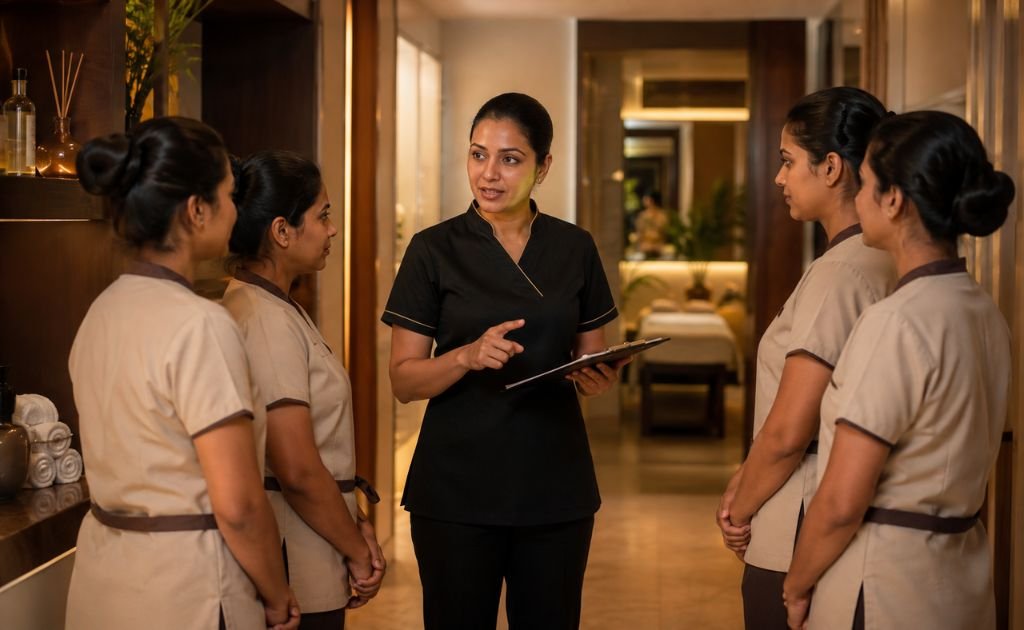
Plan for recruitment costs, joining advances, uniforms, franchisor training, and at least one month of payroll before meaningful revenue. Then plan for attrition: trained therapists are in demand across Chennai, and replacing one means recruitment, retraining and a temporary drop in capacity. Franchisors that recruit, train and supervise therapists centrally – Ashlee’s partner page lists “recruitment, training and supervision of therapists” among the things it takes care of – are effectively shifting part of this burden off the investor, which is worth understanding in detail when you compare models.
Working Capital: The Number Most Investors Forget
Revenue at a new spa builds over months, not days. Rent, salaries, utilities, consumables, software subscriptions, local marketing and maintenance are due from month one regardless. Working capital is the reserve that carries you through that ramp.
How much you need depends on your fixed monthly costs and how quickly bookings build. Rather than adopting a fixed number, build a month-by-month cash plan with a conservative ramp and hold a reserve that covers the gap plus a margin for surprises – an equipment repair, a slow monsoon month, a therapist leaving. Investors who skip this end up funding the shortfall from personal savings at the worst possible time.
Ongoing Spa Franchise Costs
Once open, expect some or all of the following, all of which vary by franchisor and must be confirmed in the agreement:
- Royalty – usually a percentage of revenue; published Indian examples range from 7–12% (FranchiseBazar’s stated range) to 15% (Allure Thai Spa, Green Day Spa, SPALON listings).
- Marketing contribution – a further 1–3% of sales in the FranchiseBazar range, or a fixed monthly amount.
- Software and technology fees for booking, POS or CRM platforms.
- Product purchase obligations – oils, consumables and retail stock from nominated suppliers.
- Renewal fees at the end of the agreement term (Allure states nil; others charge).
- Ongoing training for new staff or new therapies.
- Brand compliance – periodic interior refreshes, uniform changes, audits.
- GST on royalty and fees.
Ask for the full list in writing and model it as a percentage of projected revenue.
Spa Franchise ROI and Profitability: How to Think About It
No responsible guide can promise you a return. What it can do is show you the levers.
Revenue = bookings per day × average transaction value × operating days, adjusted for therapist utilisation (how many of your available treatment hours are actually sold) and repeat-visit rate.
Gross margin = revenue minus direct consumables and therapist incentives.
Operating expenses = rent, salaries, utilities, marketing, royalty, software, maintenance.
Operating profit = gross margin minus operating expenses.
Payback = total initial investment ÷ average monthly operating profit.
Seasonality matters (wedding season lifts salon and bridal demand; monsoon weeks soften walk-ins), and so does pricing discipline. Published break-even claims range from “3–4 months” on one brand page to “two to three years” in directory commentary – treat every such claim as marketing until you have seen the unit-level data behind it.
Illustrative Unit Economics
Illustrative example only – not an Ashlee Spa forecast or guarantee. Figures are round numbers chosen to show the method, not any brand’s actual performance.
| Line item | Assumption | Monthly figure |
| Bookings per day | 14 | – |
| Average customer spend | ₹2,000 | – |
| Operating days | 28 | – |
| Revenue | 14 × ₹2,000 × 28 | ₹7,84,000 |
| Staff costs | 8 staff incl. incentives | ₹2,60,000 |
| Rent and maintenance | Upper-floor arterial location | ₹1,20,000 |
| Royalty + marketing | 12% of revenue | ₹94,000 |
| Consumables and laundry | 8% of revenue | ₹63,000 |
| Utilities, software, misc. | – | ₹55,000 |
| Illustrative operating contribution | before owner’s salary, tax, depreciation and loan interest | ₹1,92,000 |
Change any assumption – 10 bookings a day instead of 14, or rent 50% higher – and the contribution changes sharply. That sensitivity, not the headline, is what you should test against your own location.
Franchise vs Independent Spa
| Factor | Franchise | Independent Spa |
| Brand | Established name and recall from day one | Built from zero; full ownership of the brand |
| Setup support | Layout, vendor and equipment guidance | Self-managed or via consultants |
| SOPs | Provided and audited | Must be written and enforced yourself |
| Training | Structured programme, often central | Sourced independently |
| Marketing | Central campaigns plus local support | Entirely self-funded and self-run |
| Flexibility | Menu, pricing and interiors within brand standards | Complete freedom |
| Initial fee | Franchise fee plus GST | None |
| Ongoing fees | Royalty, marketing, possibly software | None, but you fund all marketing |
| Control | Shared with franchisor | Total |
| Risk | Lower execution risk, contractual obligations | Higher execution risk, no exit constraints |
An experienced operator with a strong local network may do better independently; a first-time investor buying systems, training and brand recall usually gets more from a franchise – provided the franchisor actually delivers them.
How to Choose a Spa Franchise: Due-Diligence Checklist
- Brand reputation – review volume and quality across branches, not just the flagship.
- Existing outlets – how many, how old, how many have closed.
- Franchisee or partner references – speak to at least two.
- Full investment schedule in writing, with inclusions and exclusions.
- Royalty, marketing fee and any software fees, with GST treatment.
- Agreement duration, renewal terms and renewal fee.
- Exit and transfer terms, including any buyback.
- Territory – exclusivity radius and what happens if the brand opens nearby.
- Location support – who approves the site and on what criteria.
- Training and recruitment – who hires, who trains, who replaces.
- Operations model – FOFO (you operate), FOCO (franchisor operates) or hybrid, and how revenue is shared under each.
- Procurement – mandated suppliers and margins.
- Marketing – what central marketing actually delivers locally.
- Technology – booking, CRM and reporting you will have access to.
- Unit economics – ask for anonymised performance data and validate assumptions independently.
15 Questions to Ask Before Investing
- What is the total initial investment, itemised?
- What is the franchise fee, and is GST extra?
- Exactly what does the franchise fee include?
- What is the minimum and ideal carpet area, and how many treatment rooms does it assume?
- What is the royalty, and is it on gross or net revenue?
- Is there a marketing fee, and how is it spent?
- What working capital do you recommend, and on what ramp-up assumption?
- What support is provided between signing and opening, and over what timeline?
- What training is included, where, and for how many staff?
- Who recruits therapists, and who replaces them when they leave?
- How is a location approved, and can you share the criteria?
- What are the renewal terms and fees?
- What are the exit and transfer terms?
- May I speak to existing franchisees or partners?
- Which financial assumptions should I validate independently before signing?
Is a Spa Franchise a Good Investment?
It can be, for the right investor in the right location, and a poor one when any fundamental is missing. Attractiveness depends on location economics (rent versus achievable bookings), capital you can commit without starving working capital, real local demand and repeat visits, operating costs, availability of trained therapists, the brand’s actual strength in your city, the quality of franchisor support, how involved you intend to be, and unit economics you have stress-tested yourself.
A practical test: build your own monthly model with conservative assumptions, confirm every fee in writing, talk to existing partners, then compare brands. If the numbers work at 70% of the franchisor’s projection, you have a margin of safety. If they only work at 100%, keep looking.
Ashlee Spa & Salon: Franchise and Partnership Opportunity
Ashlee Spa & Salon is a Chennai wellness brand operating since 2016, currently with seven branches listed on its contact page – Velachery, Mylapore, Tambaram, Perumbakkam, Thoraipakkam, Pallavaram, and SkyOne., – offering Thai, Western and organic, Ayurvedic and signature therapies alongside foot spa, salon and bridal services.
Ashlee publicly invites business partnerships through its Partner With Us page, which describes three models:
- Hotels and resorts – a professionally run in-house spa for guests.
- Malls and commercial spaces – converting under-used areas into wellness zones.
- Franchise / investors – for those who “own or plan to lease a suitable space and want to enter the spa and wellness segment”, with Ashlee providing “brand, training and operational playbooks”, a “ready-made spa concept, centralised marketing and ongoing support”.
The page lists what Ashlee takes care of: spa layout guidance, interiors and ambience standards; recruitment, training and supervision of therapists; daily operations, inventory, hygiene protocols and service audits; and local marketing support, offers and digital presence.
What is not published – and what you should confirm directly: Ashlee does not publish a franchise fee, total investment, royalty, space requirement, agreement term or return figures. The investment for an Ashlee unit depends on the format (hotel, mall or standalone), location, carpet area, interior specification, equipment and working capital. Any number you see elsewhere for “Ashlee Spa franchise cost” is not from Ashlee. The only reliable way to get it is to enquire with your proposed location and format, and to ask the fifteen questions above.
Why Ashlee may be relevant to an investor – based only on what is verifiable: a decade of continuous operation in one city, seven operating branches across mall, high-street and upper-floor arterial formats, a spa-plus-salon mix that spreads revenue across massage, beauty and bridal demand, published service pricing, and an active in-house digital marketing presence. These are facts about the operating business, not a guarantee that any franchise unit will succeed; that depends on your location, capital and the terms you agree.
Interested in exploring an Ashlee Spa business opportunity?
to discuss availability, investment requirements for your format and location, site criteria and next steps.
Frequently Asked Questions
How much does a spa franchise cost in India?
Published examples checked in August 2026 range from about ₹10–15 lakhs for compact formats to ₹1 crore or more for premium wellness spas (FranchiseBazar tiers), with brand pages such as Tattva Spa quoting “₹40 lakhs onwards” and Allure Thai Spa ₹35–60 lakhs depending on format. The final figure depends on brand, format, city, area, interiors, equipment and working capital.
What is included in the total spa franchise investment?
Typically the franchise fee, interiors, equipment, furniture, property deposit, licences, initial inventory, launch marketing and technology. Working capital and GST are often excluded from headline figures, so ask for an itemised schedule.
What is a spa franchise fee?
A one-time payment for brand rights and initial onboarding. FranchiseBazar cites a typical ₹3–6 lakh range for Indian spa brands; published brand examples include ₹5 lakh and ₹10 lakh + GST (Allure Thai Spa). Larger brands charge more.
How much does a spa franchise cost in Chennai?
Chennai-relevant published examples include Le Bliss Spa (“35 lakhs”, 10% royalty) and Green Day Spa (≈₹26–52 lakhs via SMERGERS). Rent, deposit and fit-out vary sharply between high-street, mall and upper-floor arterial locations. Ashlee Spa does not publish a figure; confirm directly.
What are the ongoing costs of a spa franchise?
Royalty, marketing contribution, software fees, product purchases, renewal fees, ongoing training, brand-compliance refreshes and GST on fees — plus normal operating costs such as rent, salaries, utilities and consumables.
Does a spa franchise charge royalty?
Most do. Published Indian examples range from 7–12% (FranchiseBazar’s stated range) to 15% of monthly revenue (Allure Thai Spa, Green Day Spa, SPALON listings). A few brands waive royalty in the first year.
How much working capital is needed?
Enough to cover rent, salaries, utilities, consumables and marketing until revenue stabilises, plus a margin for surprises. Build a month-by-month cash plan rather than relying on a fixed rule of thumb.
What is the minimum space required for a spa franchise?
Published brand requirements range from under 500 sq ft for compact formats to 2,000+ sq ft for premium spas. Decide how many treatment rooms your plan needs and work backwards.
Is a spa franchise profitable?
It can be, depending on bookings, average spend, therapist utilisation, rent, salaries and fees. Model your own unit economics and stress-test them; do not rely on franchisor projections alone.
How long does a spa franchise take to break even?
Published claims range from a few months to two to three years. Your payback depends on total investment divided by real monthly operating profit, which you should estimate conservatively for your location.
What is the difference between FOFO and FOCO spa franchises?
In FOFO (franchise owned, franchise operated) you run the unit and pay royalty. In FOCO (franchise owned, company operated) the franchisor runs daily operations and revenue is shared; the investor is more passive but usually gives up a larger share.
Does Ashlee Spa offer a franchise opportunity?
Yes. Ashlee Spa & Salon’s Partner With Us page invites enquiries for hotel, mall and franchise/investor partnerships and lists the operational support it provides. Investment, fees and terms are not published and should be confirmed directly with Ashlee for your proposed format and location.